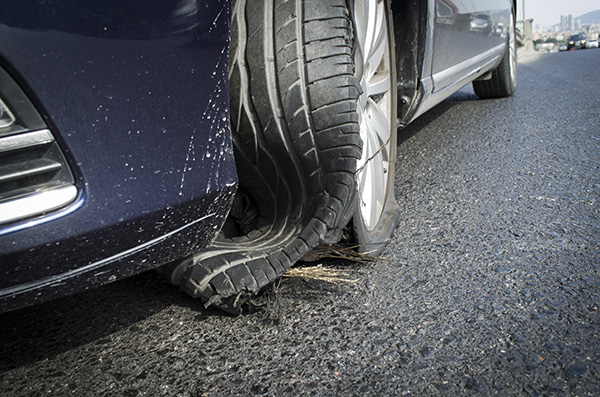
A tire blowout can produce a loud bang, sudden vibration, pulling, or a loose feeling from the rear of the vehicle. Your first reaction has a major effect on what happens next. The priority is to maintain control, reduce speed gradually, and move completely away from traffic.
Do not slam on the brakes or make a sharp steering correction. Either action can upset the vehicle while one tire is no longer supporting its share of the load. Keep your attention on the road and follow a controlled sequence.
Hold The Steering Wheel Firmly
Place both hands on the steering wheel and keep the vehicle traveling as straight as possible. A failed front tire may pull the steering wheel toward the damaged side. A rear blowout can cause the back of the vehicle to wobble or move sideways.
Do not try to correct every small movement. Large, sudden steering inputs can make the vehicle less stable. Look toward the open roadway ahead and make only the adjustments needed to remain in your lane.
Keep your body against the seatback and avoid reaching for the hazard light switch immediately if doing so requires taking a hand off the wheel. Stabilizing the vehicle comes first. State driver-safety guidance consistently advises drivers to grip the wheel firmly and maintain a straight path after tire failure.
Do Not Slam On The Brakes
Hard braking transfers weight forward and can make a damaged tire harder to control. It may also cause the vehicle to swerve, particularly when a front tire has failed.
Keep your foot off the brake during the first moments unless you must avoid an immediate collision. Hold a steady course, then ease off the accelerator and allow the vehicle to slow naturally. The damaged tire creates considerable rolling resistance, so speed will begin falling.
Once the vehicle has slowed substantially and feels stable, gentle braking may be used if necessary. Avoid pressing and releasing the brake aggressively. Official driving guidance recommends staying off the brake initially and reducing speed gradually after a blowout.
Move Toward A Safe Stopping Area
Check your mirrors and surrounding traffic after the vehicle is under control. Turn on the hazard lights, signal your movement, and begin working toward the right shoulder or another safe stopping area.
Do not cross several lanes immediately. Allow traffic to pass and move over one lane at a time when space is available. If the left shoulder is the only safe option, use it rather than forcing an unsafe move across heavy traffic.
Choose a location that places the entire vehicle beyond the travel lane. A wide shoulder, parking area, highway exit, or protected roadside space is preferable to stopping near a curve, hill, bridge, or narrow shoulder. Continue at low speed only as far as necessary to reach safety.
What Not To Do During A Blowout
Several natural reactions can increase the risk of losing control.
- Do not jerk the steering wheel
- Do not slam on the brakes
- Do not accelerate aggressively
- Do not stop in an active traffic lane when the vehicle can still move
- Do not attempt a high-speed lane change
- Do not continue driving normally on the damaged tire
- Do not exit the vehicle until you evaluate surrounding traffic
The tire is already damaged. Your immediate responsibility is controlling the vehicle and protecting its occupants, not trying to preserve the wheel or tire at the expense of personal safety.
Stay Safe After The Vehicle Stops
Place the transmission in Park, set the parking brake, and keep the hazard lights operating. If you are stopped near fast-moving traffic, remain inside with your seat belt fastened unless the vehicle is in immediate danger.
Call roadside assistance and clearly describe your location, travel direction, nearest exit, and shoulder position. Emergency services should be contacted when the vehicle blocks a lane, a collision has occurred, someone is injured, or traffic conditions create an immediate hazard.
Changing a tire beside a highway is dangerous when the shoulder is narrow, or traffic passes close to the vehicle. Do not stand between the vehicle and moving traffic. A tire can be replaced later; personal safety takes priority.
Do Not Keep Driving On The Damaged Tire
Driving farther than necessary can destroy the tire, bend the wheel, damage the wheel well, pull on brake hoses, and harm suspension components. Loose tread can strike the body, bumper, lighting, or nearby vehicles.
Even when the tire still appears attached, its internal structure may have separated. Stop as soon as a safe location is available and have the vehicle towed or the spare installed correctly.
Afterward, an inspection should include the wheel, brake components, suspension, inner fender, and nearby wiring. The other tires should also be checked because age, low pressure, overloading, or road damage may affect more than one tire.
Reduce The Risk Of A Future Blowout
Proper tire pressure is one of the strongest protections against tire failure. Check pressure when the tires are cold and use the value listed on the driver’s door placard. Underinflation creates excess sidewall flex and heat, while overloading places more stress on the tire structure.
Regular maintenance should include checking tread depth, sidewall condition, tire age, uneven wear, and signs of impact damage. Bulges, exposed cords, deep cracks, repeated pressure loss, or vibration require prompt service. NHTSA identifies correct inflation, load control, hazard avoidance, and tire checks as key steps for reducing blowout risk.
Get Tire Service In Suwanee And Decatur, GA, With Neighborhood Tire Pros
Neighborhood Tire Pros serves drivers in Suwanee and Decatur, GA. Our team can check tire pressure, tread condition, wheel damage, alignment-related wear, and suspension concerns after a blowout or before your next highway trip.
Contact us to schedule tire service and make sure your vehicle is ready for the road.